Identify exposed hanging anthers in a wind-flower photograph
Use the grass photograph to connect anther shape and position with pollen release.
Section 16.3 · Sexual reproduction in plants
Core and Extended; Biology 0610, 2026–2028. Use the stated specimen features and evidence. Diagrams are schematic. Written practice is self-checked
Before you begin
- Recall gametes, nuclear fusion, cellular respiration and the distinction between reproduction and growth.
Work on paper. Try each question before revealing help, and explain why your method works.
Quick readiness check
Which feature is keyed as an anther?
What you will learn
- Locate anthers in a crowded real flower view
- Explain how exposed positions assist wind transfer
Identify exposed hanging anthers in a wind-flower photograph
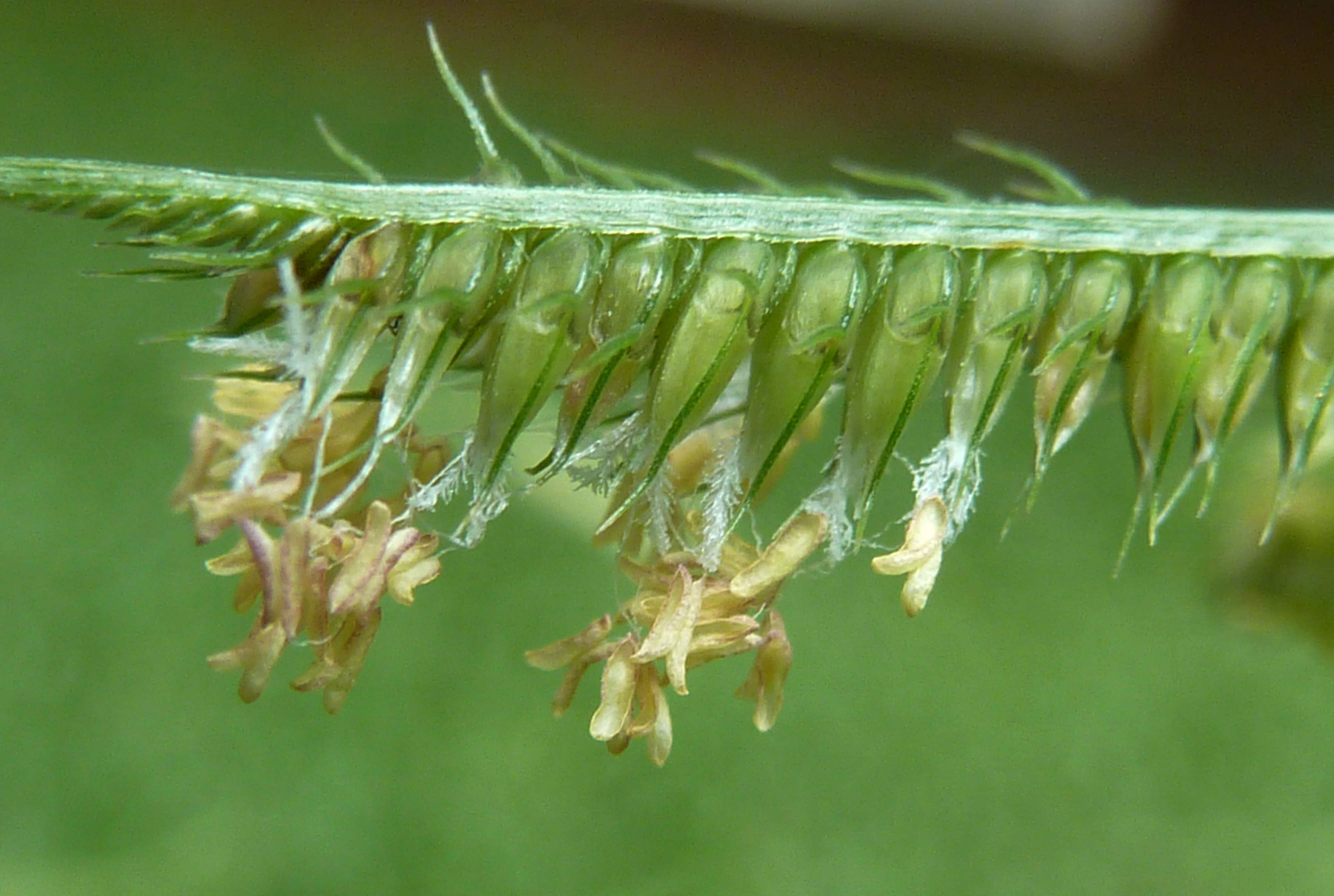
Hanging anthers and feathery stigmas · grass florets

Enlarge image for inspection
Inspect the unchanged original at its native pixel size. Scroll inside the image to follow the structures.
Check the English identification key
- hanging anthers: Cream/tan curved boat-shaped bodies dangling below the green florets, particularly the central and left clusters; a clear isolated anther is toward the right.
- feathery stigmas: Fine white branched structures emerging between the green bracts, especially immediately above the isolated right-hand anther.
- exclude awns: The long solid green pointed structures are bracts/awns, not feathery stigmas.
The photograph shows hanging anthers and feathery stigmas, but does not record wind motion or pollen transfer. Some attachments overlap or are out of focus, so use another image for complete filament or ovary identification. The solid pointed green bracts/awns are not feathery stigmas. Anther counts per individual floret and individual pollen grains are not established.
| Feature | Meaning |
|---|---|
| Anther identity | Cream/tan hanging boat-shaped body |
| Function | Produces pollen grains |
| Adaptation | Exposed position assists release into air |
| Limit | Movement and per-floret counts are not established |
Locate anthers in a crowded real flower view
The unchanged source photograph shows florets of Dactyloctenium aegyptium, a grass. Locate the cream or tan curved, boat-shaped bodies dangling below the green florets. The source caption and identification key identify these as anthers. An isolated example toward the right gives a useful starting point before inspecting the more crowded central and left-hand groups.
These exposed anthers are positioned where air movement can shake or carry released pollen away. This links structure and function: pollen is produced in the anther, and a hanging position outside the small flower can make release into moving air easier. The wind does not produce pollen and the filament does not replace the anther as its producing structure.
Explain how exposed positions assist wind transfer
Compare this position with the supplied insect-flower model, whose reproductive parts are placed to contact visitors. The comparison concerns pollen transfer opportunities rather than a universal rule that every wind flower looks identical. In the real photograph, some attachment filaments and floret bases are overlapped or out of focus; it is suitable for exposed-anther identification, but is not the primary image for counting stamens or locating every filament.
A still photograph can show shape and position, but cannot prove that wind was blowing, pollen was released at that instant or grains reached a receptive stigma. It also does not resolve individual pollen grains or their nuclei. Explain the adaptation from the documented anatomy while keeping a proposed transfer mechanism separate from a directly recorded transfer event.
Pause and explain
How does an exposed hanging position help?
Worked example
Which visible bodies support the identification of exposed anthers?
Show the worked solution
- Locate the hanging cream boat-shaped bodies below green florets.
- Use the source key rather than the white feathery structures.
Answer The cream/tan hanging boat-shaped bodies.
Try a topic test
Choose Easy, Normal or Difficult. Save your answers and open worked review after finishing.
Test this topic →From guided practice to a new situation
Write your answer and reasoning first. Use a hint only if you are stuck. The model solution is for self-checking; your written work is not automatically marked.
Describe the appearance and position of anthers in the supplied grass photograph.
Give me a hint
Begin with the isolated right-hand example.
Compare my reasoning
- Cream/tan curved boat-shaped bodies are visible.
- They hang below the green florets.
Exposed cream or tan boat-shaped anthers dangle below the green florets.
Look for these in your work
- Describe shape
- Describe the exposed hanging position
Explain why anthers hanging outside a wind-pollinated flower can aid pollen transfer.
Give me a hint
Link exposure with release into air.
Compare my reasoning
- Anthers produce pollen.
- Air movement can shake or carry released grains from exposed anthers.
Their exposed hanging positions allow air movement to assist pollen release and carry grains away; anthers remain the pollen-producing organs.
Look for these in your work
- Connect structure and release
- Keep production distinct from transport
Does the photograph alone prove successful pollination or an exact anther count per floret?
Give me a hint
Check movement and overlapping boundaries.
Compare my reasoning
- A still image does not record transfer.
- Crowded florets obscure individual attachments.
No. It supports exposed-anther identification, but does not record transfer or establish a reliable count for each individual floret.
Look for these in your work
- State the supported identification
- Retain both evidence limits
Common mistakes
- Calling the white feathery stigmas anthers.
- Claiming the still image records wind transfer.
What can you explain now?
How does an exposed hanging position help?
Compare with the explanation
It assists pollen release into moving air
This is a structure–function explanation.
After trying it yourself, choose your next review. This is your self-assessment.
Your review choice appears on Today. Sign in to sync it across devices.
Make it stick
Identify hanging wind-flower anthers and link their position with pollen release.
If you needed the solution, close it and solve the problem again from a blank page. A correct answer is stronger when you can explain the reason for each step.