Identify feathery stigmas in a wind-flower photograph
Distinguish receiving surfaces from anthers and solid green awns.
Core and Extended; Biology 0610, 2026–2028. Use the stated specimen features and evidence. Diagrams are schematic. Written practice is self-checked
Before you begin
- Recall gametes, nuclear fusion, cellular respiration and the distinction between reproduction and growth.
Work on paper. Try each question before revealing help, and explain why your method works.
Quick readiness check
What is the function of the feathery stigma?
What you will learn
- Locate the fine branched stigma surfaces
- Link the receiving area with interception of airborne pollen
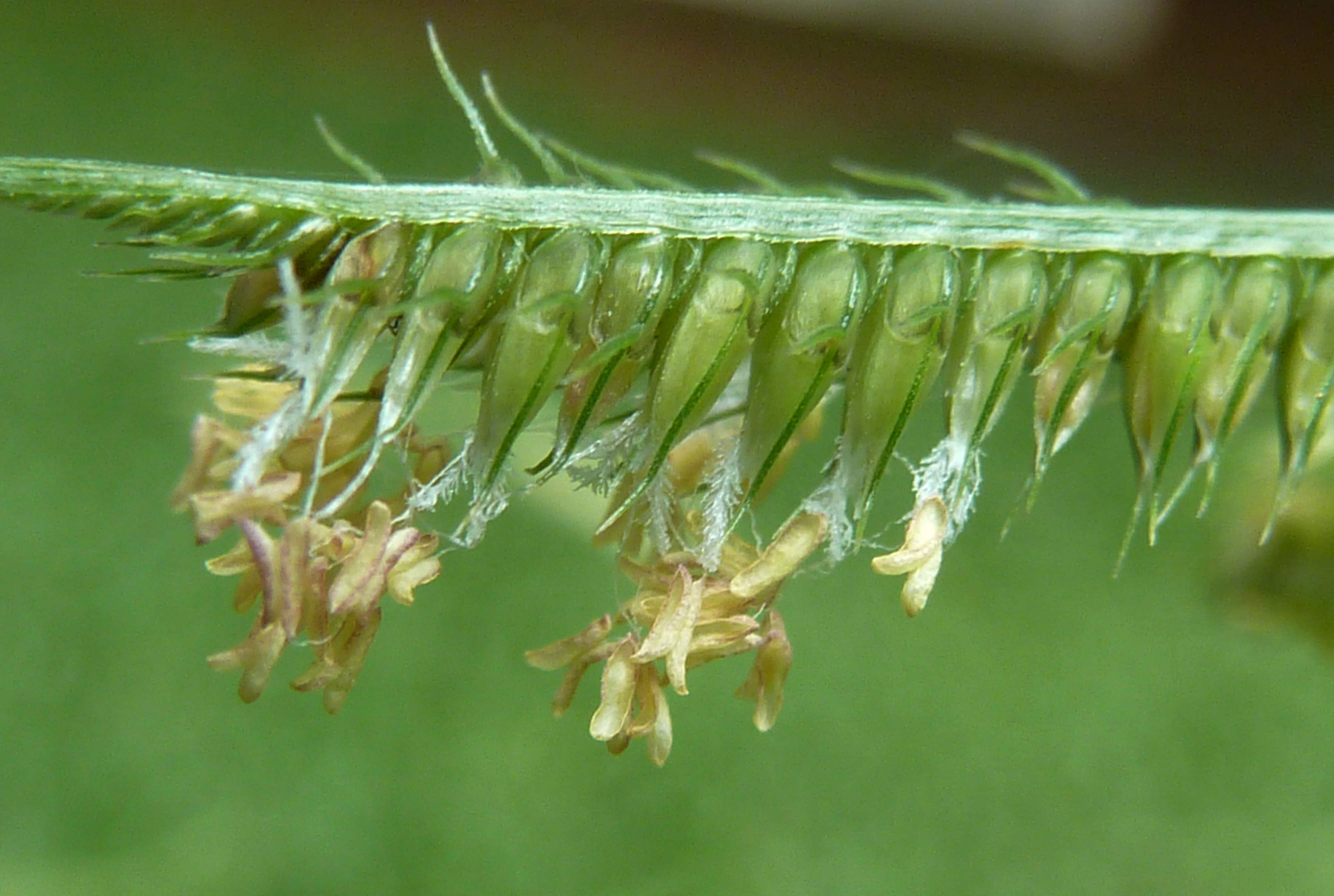
Identify feathery stigmas in a wind-flower photograph
Hanging anthers and feathery stigmas · grass florets

Enlarge image for inspection
Inspect the unchanged original at its native pixel size. Scroll inside the image to follow the structures.
Check the English identification key
- hanging anthers: Cream/tan curved boat-shaped bodies dangling below the green florets, particularly the central and left clusters; a clear isolated anther is toward the right.
- feathery stigmas: Fine white branched structures emerging between the green bracts, especially immediately above the isolated right-hand anther.
- exclude awns: The long solid green pointed structures are bracts/awns, not feathery stigmas.
The photograph shows hanging anthers and feathery stigmas, but does not record wind motion or pollen transfer. Some attachments overlap or are out of focus, so use another image for complete filament or ovary identification. The solid pointed green bracts/awns are not feathery stigmas. Anther counts per individual floret and individual pollen grains are not established.
| Feature | Meaning |
|---|---|
| Stigma identity | Fine white branched surface |
| Function | Receives pollen |
| Adaptation | Extensive area intercepts airborne grains |
| Excluded | Solid pointed green bracts/awns |
Locate the fine branched stigma surfaces
Return to the verified grass photograph and locate fine white branched structures emerging between the green bracts. One clear group lies immediately above the isolated anther toward the right. The source caption identifies these feathery structures as stigmas. Their many fine branches differ from the cream boat-shaped anthers and the solid pointed green structures.
A stigma receives pollen. A feathery branching surface presents an extensive area that can intercept grains carried in air. Describe the link explicitly: more exposed receiving surface increases opportunities for airborne pollen to land. This is different from producing pollen, which is the anther function, or carrying a male reproductive nucleus through a growing pollen tube.
Link the receiving area with interception of airborne pollen
The long solid green points are bracts or awns in the supplied image key; do not call them feathery stigmas simply because they extend beyond the floret. Use branching texture as visible evidence together with the documented identity. Not every branch is separately countable in this crowded view, and white appearance alone would be weak identification evidence in another source.
The anther and stigma adaptations work at different ends of the transfer route: release at the anther, reception at the stigma. The photograph supports identifying both structures, but does not show which grain came from which plant, whether a receptive stigma received compatible pollen or whether fertilisation followed. A supported adaptation explanation should not be rewritten as a recorded successful reproductive event.
Pause and explain
Which feature should be excluded from this stigma key?
Worked example
A key identifies a fine white branched surface above a hanging anther. Name it and give its function.
Show the worked solution
- The branching surface is a stigma.
- Its function is pollen reception.
Answer Feathery stigma; receives airborne pollen.
Try a topic test
Choose Easy, Normal or Difficult. Save your answers and open worked review after finishing.
Test this topic →From guided practice to a new situation
Write your answer and reasoning first. Use a hint only if you are stuck. The model solution is for self-checking; your written work is not automatically marked.
Describe where to find a clear feathery stigma in the grass photograph.
Give me a hint
Use the isolated right-hand anther as a landmark.
Compare my reasoning
- Look immediately above that anther.
- Find fine white branches emerging between green bracts.
Fine white branched structures emerge between the green bracts, including a clear group above the isolated right-hand anther.
Look for these in your work
- Use a visible landmark
- Describe the branching receiving surface
Explain how a feathery stigma assists wind pollination.
Give me a hint
Link surface area with interception.
Compare my reasoning
- Fine branches create an extensive exposed surface.
- Airborne pollen can land on that receiving surface.
Its extensive exposed branching surface increases opportunities to intercept airborne pollen grains.
Look for these in your work
- Describe the structural adaptation
- Connect it to pollen reception
Compare the roles of the hanging anthers and feathery stigmas in this grass.
Give me a hint
Use the two ends of the transfer route.
Compare my reasoning
- Anthers produce pollen and are exposed for release.
- Stigmas receive grains carried in air.
Hanging exposed anthers assist release of their pollen into air; feathery stigmas provide exposed receiving surfaces. The image does not itself prove successful transfer or fertilisation.
Look for these in your work
- Separate producing and receiving functions
- Retain the still-image evidence limit
Common mistakes
- Calling solid green awns feathery stigmas.
- Giving pollen production as the stigma function.
What can you explain now?
Which feature should be excluded from this stigma key?
Compare with the explanation
Solid pointed green bracts or awns
They lack the keyed white feathery branching structure.
After trying it yourself, choose your next review. This is your self-assessment.
Your review choice appears on Today. Sign in to sync it across devices.
Make it stick
Identify feathery stigmas and distinguish their receiving role from the pollen-producing anthers.
If you needed the solution, close it and solve the problem again from a blank page. A correct answer is stronger when you can explain the reason for each step.