Identify glands in the published testicular anatomy image
Trace adrenal, pancreatic and testicular endpoints in the unchanged Blausen image.
Core and Extended; Biology 0610, 2026–2028. Use the stated specimen features and evidence. Diagrams are schematic. Written practice is self-checked
Before you begin
- Recall electrical impulses, blood transport, gland secretion and the distinction between a stimulus and a body response.
Work on paper. Try each question before revealing help, and explain why your method works.
Quick readiness check
Which printed source target lies in the scrotum below the pelvis?
What you will learn
- Use the source views and leader endpoints
- Complete the four-gland image comparison
Identify glands in the published testicular anatomy image
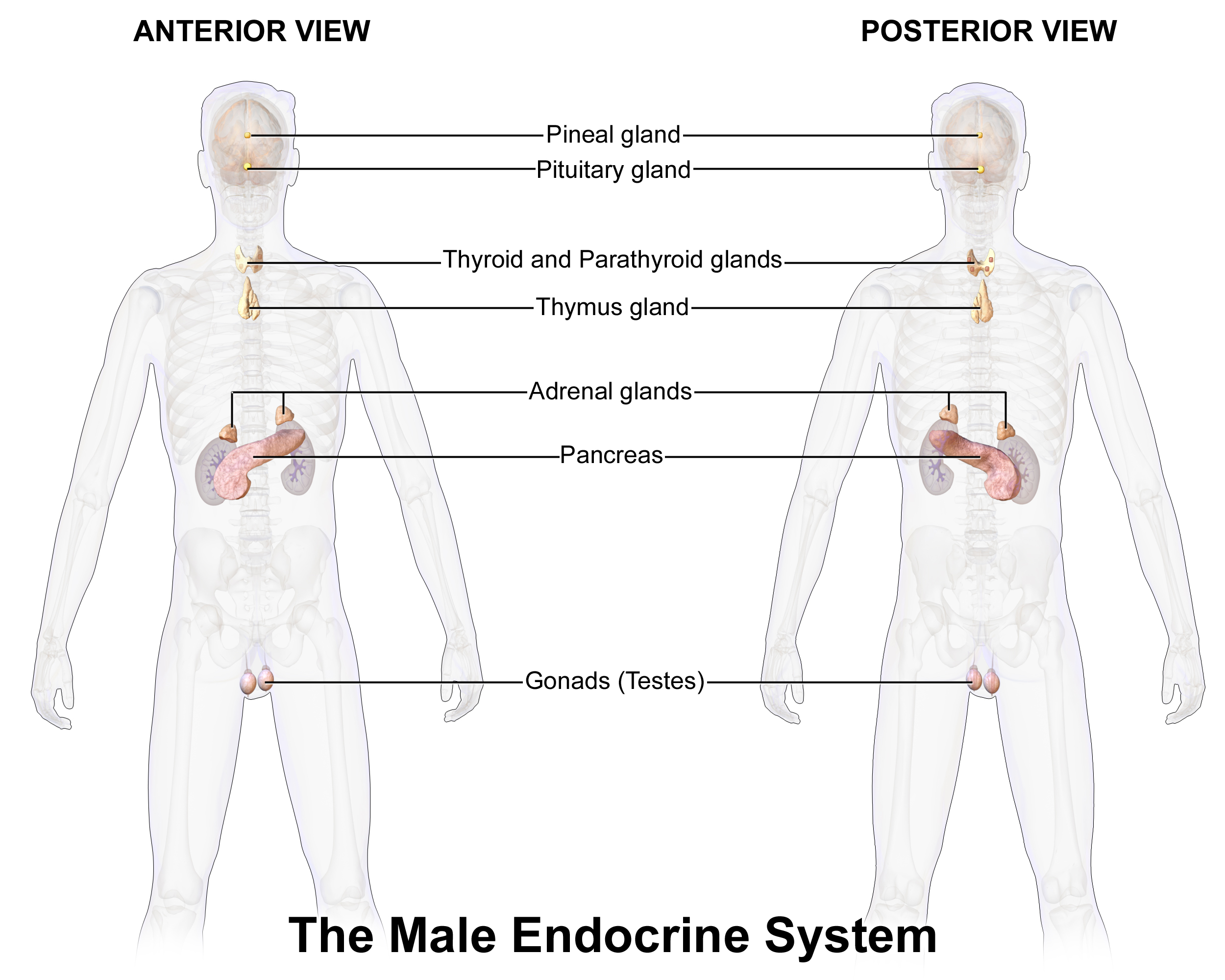
Unchanged published testicular illustration: anterior left, posterior right. The Gonads (Testes) leader reaches one of the paired scrotal testes per view. Ovaries are absent.
Enlarge image for inspection
Pan across the source at its native image size to follow the leaders. Try identification before opening the key.
Check the identification key
Adrenal glands: paired small brown caps above kidneys → adrenaline. Pancreas: pink elongated upper-abdominal gland → insulin. Gonads (Testes): one leader reaches one of the paired scrotal testes per view → testosterone. Ovaries are absent; use the companion ovarian source.
Use the source views and leader endpoints
The published Male Endocrine System image by BruceBlaus and Blausen Medical Communications shows an anterior view on the left and a posterior view on the right. Transparent anatomy reveals glands inside the outline. The drawn colours, sizes and body proportions are schematic and do not show a measured specimen or hormone secretion rate.
Adrenal glands branches towards the small brown caps above the larger kidneys. Pancreas ends in the pink elongated organ across the upper abdomen. Gonads (Testes) has one horizontal leader to one of the paired scrotal testes in each view; both testes are drawn, but this particular leader does not branch to both. The scrotal targets lie below the pelvis.
Complete the four-gland image comparison
Supply the required pairings: adrenal glands and adrenaline, pancreas and insulin, testes and testosterone. Hormone names are not printed in this source. Ovaries and oestrogen form the other required Core pairing and are shown in the separate ovarian image. Comparing both sources covers the four required glands without combining two alternative reproductive arrangements in one body.
Extra endocrine labels in the head, neck and chest do not replace the required abdominal and gonadal targets. The source does not show endocrine islets or distinguish adrenal cell regions. Follow an endpoint before naming a gland, use enlargement to inspect the unaltered picture, and compare with the closed key after attempting the identification.
Pause and explain
Which pair belongs in this source identification answer?
Worked example
Identify the scrotal source target and its required hormone.
Show the worked solution
- Gonads (Testes) ends at one of the paired testes in each view.
- Testes secrete testosterone.
Answer Gonads (Testes) identifies testes in the scrotum; their required hormone is testosterone.
Try a topic test
Choose Easy, Normal or Difficult. Save your answers and open worked review after finishing.
Test this topic →From guided practice to a new situation
Write your answer and reasoning first. Use a hint only if you are stuck. The model solution is for self-checking; your written work is not automatically marked.
Identify the three required visible glands and give their hormones.
Give me a hint
Use the adrenal, pancreatic and gonadal endpoints.
Compare my reasoning
- Adrenal glands/adrenaline and pancreas/insulin.
- Gonads (Testes) identifies testes/testosterone.
Adrenal glands–adrenaline; pancreas–insulin; testes–testosterone.
Look for these in your work
- Identify all three
- Supply each required hormone
Describe the Gonads (Testes) endpoint accurately, including how it relates to the paired organs.
Give me a hint
Count leaders separately from organs.
Compare my reasoning
- Both testes are drawn in each scrotal view.
- A single leader reaches one testis per view.
Both testes are visible, but the Gonads (Testes) label has one leader to one testis in each view. Testes secrete testosterone.
Look for these in your work
- Distinguish leader count from organ count
- State location and hormone
Combine the two published images into the complete four-pair answer.
Give me a hint
Shared adrenal and pancreatic targets occur in both.
Compare my reasoning
- Both images show adrenal glands/adrenaline and pancreas/insulin.
- The ovarian source adds ovaries/oestrogen; this source adds testes/testosterone.
Adrenal glands–adrenaline; pancreas–insulin; ovaries–oestrogen; testes–testosterone.
Look for these in your work
- Use both actual sources
- Include all four pairs
Common mistakes
- Claiming this leader branches to both testes.
- Assigning oestrogen to the printed Testes target.
What can you explain now?
Which pair belongs in this source identification answer?
Compare with the explanation
Testes–testosterone
The named gonads are testes.
After trying it yourself, choose your next review. This is your self-assessment.
Your review choice appears on Today. Sign in to sync it across devices.
Make it stick
Trace the actual scrotal endpoint and complete the four-pair image comparison.
If you needed the solution, close it and solve the problem again from a blank page. A correct answer is stronger when you can explain the reason for each step.